Before building anything, we map what exists. This means documenting every system, every data flow, every adjustment function, and every manual process across your supply chain. The result is a clear picture of where your grey area lives — the spreadsheets, the manual corrections, the macros that bridge gaps between systems.
This mapping is the foundation for everything else. Without it, any integration project is guessing.
Deliverables
- Complete system-to-system data flow map
- Identification of all manual adjustments and workarounds
- Grey area quantification report
- Integration opportunity matrix with effort/impact scoring
- Recommended UNS topology
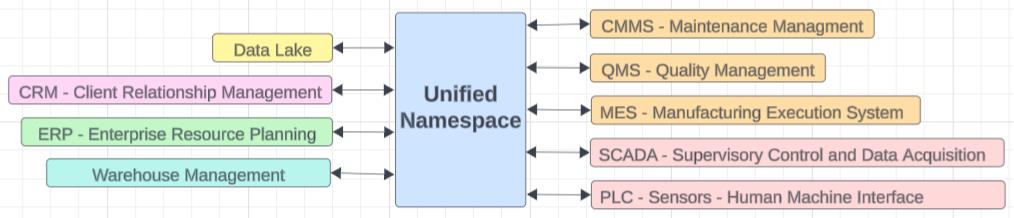
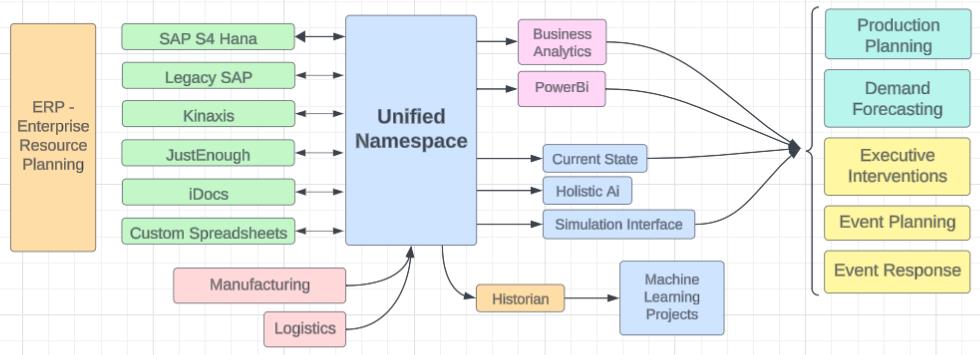
The core of what we do. A Unified Namespace is a central data exchange that sits between all your systems — ERP, MES, planning tools, sensors, spreadsheets — and provides a single, clean, real-time view of your data. Every system publishes to the namespace and subscribes from it. No more point-to-point integrations that multiply every time you add a system.
We build the UNS with a Normalise & Contextualise layer at its boundary. Data is cleaned once, at entry, not by every downstream consumer. This is what converts quadratic integration growth to linear.
Deliverables
- UNS infrastructure (MQTT/Kafka-based topic hierarchy)
- Normalise & Contextualise layer per data source
- System connectors for existing ERP, MES, planning tools
- Real-time data validation and quality monitoring
- Documentation and operational handover
Your organisation already has the answers — buried in specifications, policies, contracts, regulations, and operating procedures. We build queryable AI systems that sit on top of your own documents, making institutional knowledge accessible to anyone who needs it, when they need it.
This isn't generic ChatGPT. It's domain-specific AI trained on your data, with provenance tracking so you can see exactly which document sourced each answer.
Deliverables
- Document ingestion pipeline (PDF, Word, Excel, scanned documents)
- Vector database with semantic search
- Queryable AI interface (web-based or API)
- Source attribution and provenance tracking
- Integration with UNS for real-time document context
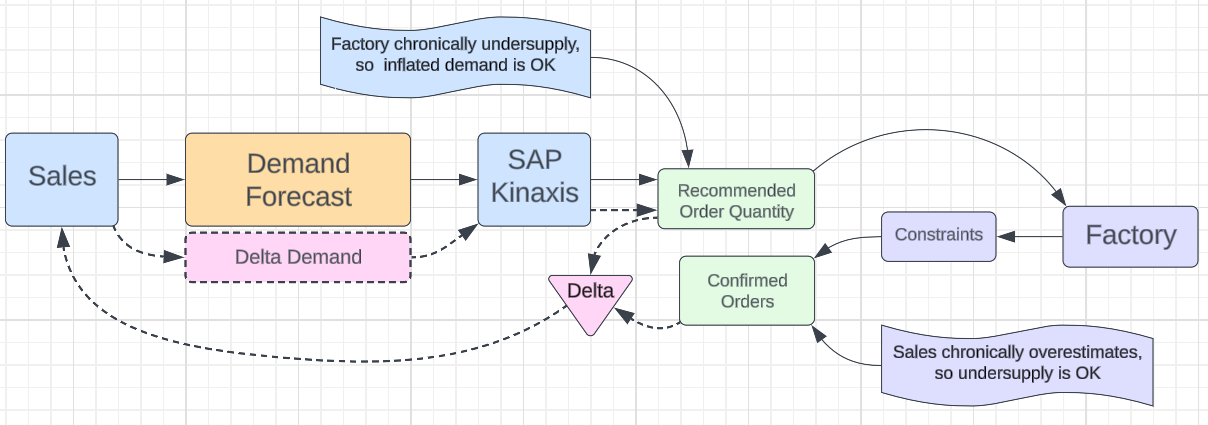
The most undervalued work in data engineering. A demand variable that contains demand plus corrections plus targets plus buffers is useless for forecasting — but this is what most organisations train their models on. We systematically identify which variables have been contaminated by accumulated corrections, separate signal from noise, and rebuild clean data pipelines.
Deliverables
- Variable audit and contamination analysis
- Signal/noise separation for key planning variables
- Clean variable pipelines (integrated with UNS)
- Data quality dashboards and monitoring
- Recommendations for process changes to prevent re-contamination
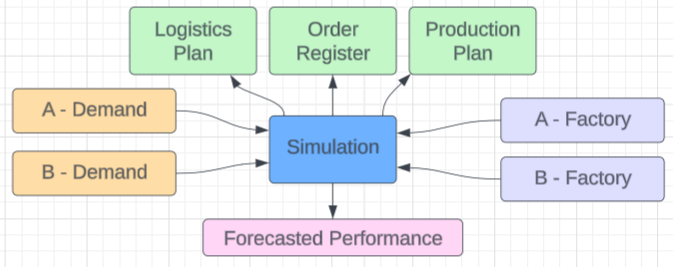
Once your data is clean and centralised, simulation becomes possible. We build physics-based simulation models that connect demand and supply, allowing you to test scenarios before committing resources. What happens if a factory goes down? What if demand shifts 20%? What's the optimal production plan given current constraints?
Deliverables
- Physics-based production simulation model
- Scenario analysis interface
- Integration with UNS for real-time constraint data
- Demand/supply reconciliation engine
- Forecasted performance dashboards
The final layer: giving leadership real-time visibility into operations with the ability to model interventions before executing them. Current state, scenario simulations, disruption response, and event management — all fed by clean UNS data rather than stale spreadsheets.
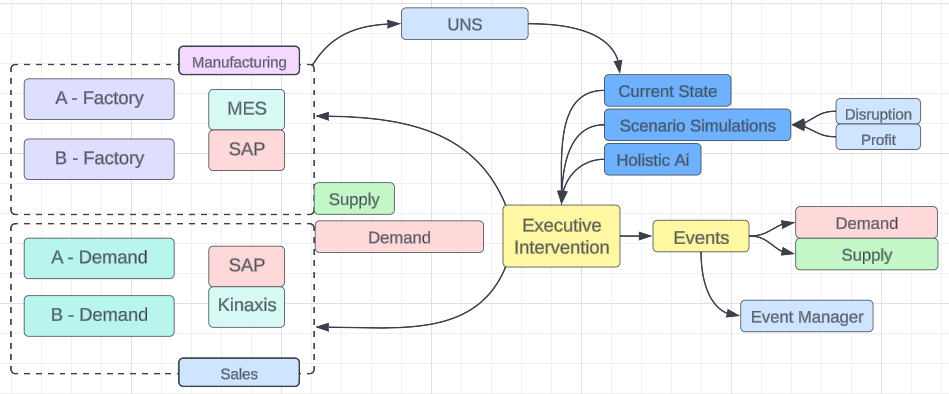
Deliverables
- Real-time operational dashboard
- Scenario simulation for executive interventions
- Event management and response tracking
- AI-assisted anomaly detection and alerting
- Integration with existing BI tools (Power BI, etc.)
Changing an ERP, planning tool, or any major system is one of the highest-risk projects in enterprise IT. With a UNS in place, this risk drops dramatically. Every system connects to the namespace — so swapping one system only requires updating one connection, not every downstream integration.
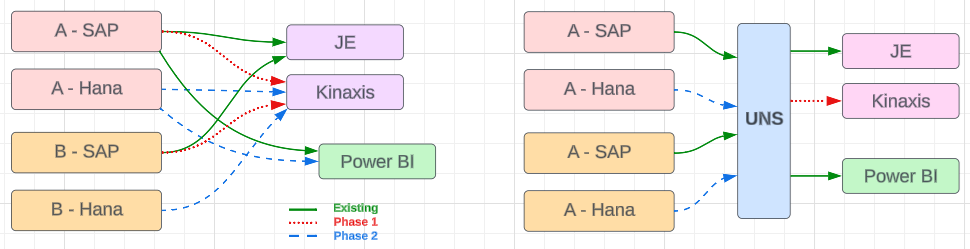
Deliverables
- Migration-safe UNS architecture
- Parallel-run capability (old + new system simultaneously)
- Connection adapter for new system
- Data validation and reconciliation during transition
- Rollback strategy and documentation