Built to deliver value,
not to drag out contracts.

The animation on our home page shows the problem. This page explains how we solve it without creating more of it.

Every aspect of how we work is designed to avoid the failure modes that plague large software implementations — change resistance, scope creep, data withholding, and the years-long gap between starting work and seeing results.

How We Think About Projects

Eight principles that shape every engagement. These aren't marketing — they're operational constraints we hold ourselves to.

Every project we deliver is scoped to 6–8 weeks. At the end of that window, there is something usable — a working integration, a clean data feed, a functional prototype. We don't do "Phase 1 of a 3-year roadmap." We do discrete, valuable blocks of work that each stand on their own. If you want more, we scope the next block. If you don't, what we built still works.
There is no handoff between the person who understands your problem and the person who solves it. The engineer in the room during discovery is the engineer who writes the code. This eliminates the "lost in translation" failures that destroy large consultancy projects.
Your ERP works. Your MES works. Your planning system works. The problem is between them. We add the connective infrastructure that makes your existing investments talk to each other — we don't ask you to rip them out and start over. This means lower risk, lower cost, and no multi-year migration.
People resist change they didn't ask for. A UNS doesn't require anyone to change how they work on day one. It connects systems in the background. Users start seeing better data, better reports, better decisions — and they adopt it because it works, not because they were told to. Change management isn't a communication plan; it's an architectural decision.
Every failed AI/ML project we've encountered failed because of data, not models. If your demand data contains demand plus corrections plus targets plus buffers, no model can extract truth from it. We fix the variable quality problem first — that's what makes downstream AI actually useful.
Everything we build is documented, transferable, and uses open standards. You will never be locked into us. If you want to hand what we've built to an internal team or another vendor, you can. We believe this is the right way to work — and that it means clients come back because they want to, not because they have to.
Data should be cleaned once, at the point it enters the UNS — not by every downstream system that consumes it. This is the fundamental architectural principle that converts quadratic integration complexity to linear. One normalisation point per data source, one canonical format in the namespace, unlimited clean consumers.
We help you identify and improve the variables that actually drive your business outcomes — not the ones that are easiest to measure. This means understanding your data deeply enough to separate signal from noise, truth from accumulated corrections, and actual demand from inflated demand.

From Discovery to Delivery

Every engagement follows this pattern. The scope and duration vary, but the structure ensures consistent results.

01

Discovery

Map existing systems, data flows, and identify the grey area. Understand where value is lost. 1–2 weeks.

02

Architecture

Design the UNS topology, normalisation rules, and integration plan. No unnecessary complexity. 1 week.

03

Build

Implement connectors, normalisation layer, and namespace. Working integration, tested with real data. 3–4 weeks.

04

Validate

Parallel run with existing processes. Prove data quality improvements. Handover documentation. 1 week.
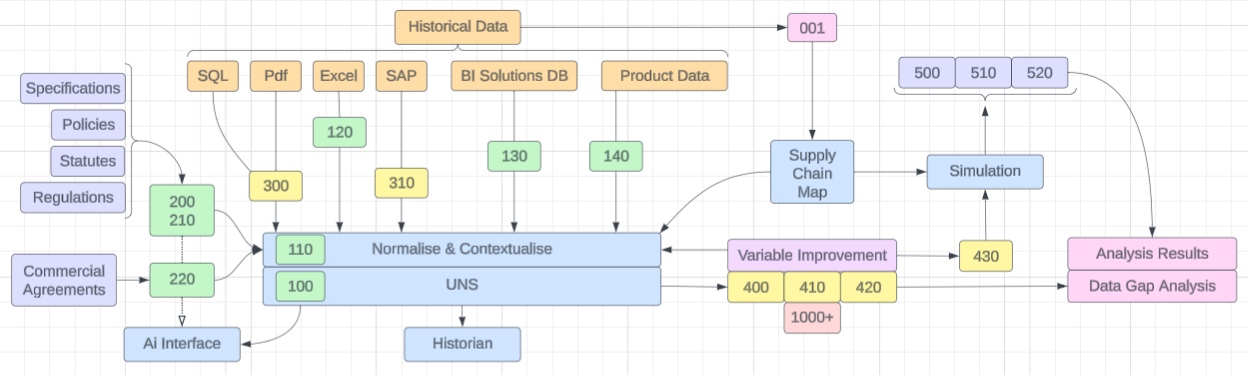
Implementation strategy showing how work streams connect — from data sources through normalisation, UNS, variable improvement, simulation, and analysis.
Implementation flow — how work streams build on each other. Data sources feed through normalisation into the UNS, enabling variable improvement, simulation, and analysis.

Ready to see how this applies
to your organisation?

We'll map your systems and show you where the grey area is — before any commitment.